For a small team where one person sells and others demo, sign and deliver
A B2B sales pipeline board for a small team: one owner and one dated next step per deal
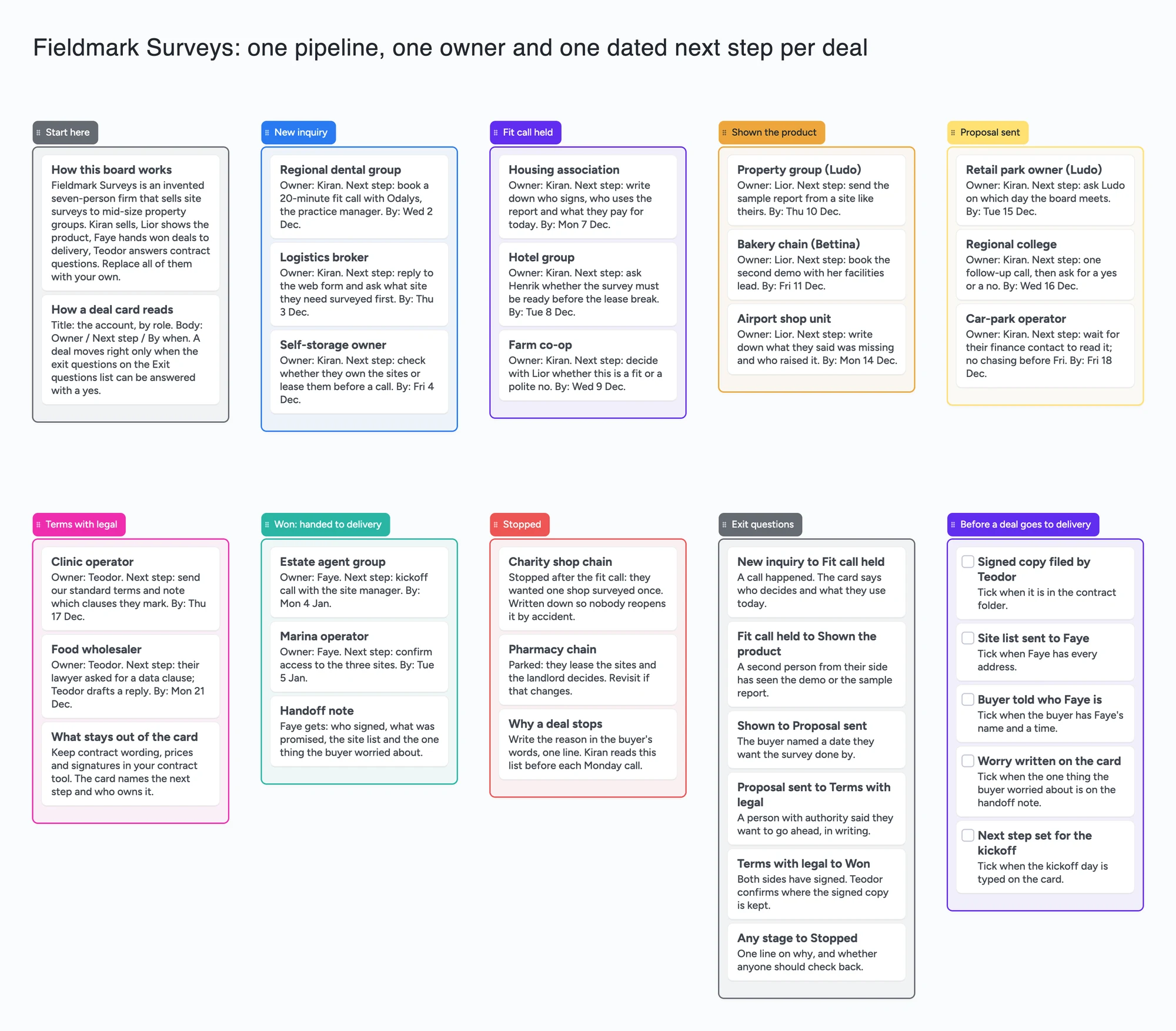
We make Instaboard, an online board. This page gives you a B2B sales pipeline already laid out and filled in for an invented firm, Fieldmark Surveys, with fourteen open deals moving across New inquiry, Fit call held, Shown the product, Proposal sent and Terms with legal, then Won or Stopped. It is a board you read by eye. It does not add up deal values, forecast, link email or remind anyone, and a CRM such as HubSpot's or Pipedrive's does those jobs better. Use the board for the part a CRM leaves to people: who owns the next step on each deal and what has to be true before it moves.
Opens in your browser. Anyone can view; a free sign-in lets you edit.
Updated
The short version
- What it is: one screen where a small team sees every open deal, who owns its next step and by when. Fieldmark's board uses 45 of your 150 free items.
- What a stage means: a stage is something the buyer did (a call held, a demo seen, a date named), not a task on your side. The Exit questions list writes the test for each move.
- What it is not: no deal values, no totals, no forecast, no email link, no reminders or due-date alerts. Dates are typed in each card.
- When to skip it: with more than a few dozen live deals, or if you need email on each deal, a CRM is the better home (the table below says where).
- Free plan: 5 boards, 150 items and 3 pictures per board. Pro removes the item limit; the last FAQ has the prices.
A stage is something the buyer did
Two sources we read on November 25, 2026 say the same thing about stages in different words. A reply by danmoyle in HubSpot's community forum (a thread started by a Community Champion in December 2025, marked solved) advises one pipeline with a few stages "aligned to key buyer milestones, not internal tasks", each with one to three exit criteria a rep can memorize. Pipedrive's pipeline guide (page dated September 23, 2026, a vendor blog) says every stage needs "a clear purpose, objective, exit criteria and a defined next action".
Fieldmark's stages follow that. A deal is in Fit call held because a call happened, in Shown the product because a second person from their side has seen the demo or a sample report, in Proposal sent because the buyer named a date they want the work done by. The board writes each test on one card in the Exit questions list, so a stage move is a yes to a plain question.
danmoyle's post also gives a percentage for each stage (10% at New Inquiry up to 90% at Verbal Commit). This board has none. A card can hold a typed number, but turning those numbers into a weighted forecast needs a sum, and a card cannot add anything up.
Fieldmark's board, list by list
The firm is invented: Kiran sells, Lior shows the product, Faye takes won deals into delivery and Teodor answers contract questions. Deal cards read Owner, Next step and By, with the account named by its role or a first name.
| List | Whose it is | In Fieldmark's board |
|---|---|---|
| New inquiry (blue) | Kiran | "Regional dental group" Owner: Kiran. Next step: book a 20-minute fit call with Odalys, the practice manager. By: Wed 2 Dec |
| Fit call held (purple) | Kiran | "Housing association" Owner: Kiran. Next step: write down who signs, who uses the report and what they pay for today. By: Mon 7 Dec |
| Shown the product (orange) | Lior | "Bakery chain (Bettina)" Owner: Lior. Next step: book the second demo with her facilities lead. By: Fri 11 Dec |
| Proposal sent (yellow) | Kiran | "Car-park operator" Owner: Kiran. Next step: wait for their finance contact to read it; no chasing before Fri. By: Fri 18 Dec |
| Terms with legal (pink) | Teodor | "Food wholesaler" Owner: Teodor. Next step: their lawyer asked for a data clause; Teodor drafts a reply. By: Mon 21 Dec |
| Won: handed to delivery (green) | Faye | "Estate agent group" Owner: Faye. Next step: kickoff call with the site manager. By: Mon 4 Jan |
| Stopped (red) | Kiran | "Charity shop chain" Stopped after the fit call: they wanted one shop surveyed once |
Swipe the table sideways to see every column.
The board's own wording. On this board the owner and the date are typed in the card text.
Four lists are not stages: Start here, Stopped, Exit questions and Before a deal goes to delivery. Exit questions (grey) holds the six yes-or-no tests. Before a deal goes to delivery (purple) is a list of five tick-box cards, one for each thing Faye needs. A tick carries no name or time, so a ticked box only means somebody ticked it.
How many deals fit in 150 items
Our arithmetic. Each list and each card is 1 of your 150 free items across all your boards; arrows, sections and pen strokes don't count. Fieldmark's board is 10 lists + 34 cards + 1 title text box = 45. If it is your only board, 150 − 45 leaves 105 items, which is about that many more deal cards. Stopped and Won cards still count until you delete them, and a pipeline that outgrows that number is a sign to move to a CRM.
The one line every deal card needs: a date you can check
An October 21, 2026 (UTC) r/startups thread, "Founders who built your own sales process, how did you do it? I will not promote" (Reddit shows 44 comments; we read 25 in an archived copy), is mostly about writing a sales process down: record calls and tag objections, put a won deal beside a lost one. One reply is about checking a pipeline. u/Pipelinenothustle, who says they spent 12 years running industrial B2B teams, writes that after a handoff they "skip 'how is the deal going'" and ask "for the date of the next thing that happens", because "~70% is a feeling" and a date is "a date you can check".
That is the reason every deal card here ends with a By date and a named owner. The board cannot tell you the date has passed; a person reading the list on Monday can. It is one person's view, from a thread where other replies said to sell the first deals yourself before handing the process to anyone.
Spreadsheet, CRM or board: what two small-team threads say
A February 12, 2026 (UTC) r/startups thread, "I will not promote: best crm tools for a small bootstrap startup?" (Reddit shows 38 comments; we read 22 with text in an archived copy, 16 more removed or deleted), asks what a team of two to five should use once spreadsheets break. Many replies are tool promotions and the moderators removed some. The ones that answer:
- u/vatoho tried Notion and Airtable first: "it worked until like 50 leads, then it just fell apart". They moved to Pipedrive, "solid for the price", and wrote that the "hubspot free tier is also decent but gets expensive fast once you need actual features". The same comment recommends another product, so read it as vendor-adjacent, as u/algo46's is.
- u/algo46 disagrees with the whole premise: "you might not need a full CRM yet at 2-5 people". They go on to name a product they use, so read that as a vendor-adjacent voice.
- u/Negative-Fly-4659 suggests a 14-day pilot of one tool with three numbers: time to update a deal after a customer touch, share of overdue follow-ups, and forecast accuracy against actual closes.
- u/amberjletang puts it as a choice by job: HubSpot for a safe default, Pipedrive for pure deal tracking, Close for heavy outbound.
None of the replies we read suggests a shared board, and we make one, so take that as the honest limit of this page. Our reading: the people asking want automation and follow-up discipline, and a board gives them neither. It fits the stage before that, when the pipeline is a few dozen deals and the question is who owns what.
Where a spreadsheet or a CRM does this better
| Tool | What its own page says (read November 25, 2026) | When it wins over this board |
|---|---|---|
| HubSpot free CRM | Its page says the free CRM is "100% free with no expiration date" and lists deals, tasks and activities, pipeline management that predicts "future revenue based on how likely deals and clients will close", and a reporting dashboard. No date printed | You want a forecast, reports or tasks tied to each contact |
| Pipedrive | Its guide (dated September 23, 2026) says a good CRM links contacts to deals, integrates email, shows team sales data in real time and automates tasks. Its pricing page (read in a browser November 26, 2026) lists Lite at US$14 per seat per month billed annually (US$168 a year) and Growth at US$39 per seat per month billed annually (US$468 a year), with a 14-day trial | You want email on each deal and automatic follow-ups |
| A spreadsheet | Pipedrive's guide says you can build a pipeline with tools "from sticky notes to an Excel spreadsheet", and that with a complex or long sales cycle, or more than 10 contacts, a spreadsheet "is likely to get out of hand pretty quickly" | You want sums, filters and a deal-value column |
| Instaboard | One shared board; lists are stages, owners and dates typed by hand; no totals, forecast, email link or alerts | A few people share a small pipeline and want to see who owns each next step on one screen |
Swipe the table sideways to see every column.
Each cell is the page's own wording, read on the date above. Vendor claims are the vendor's.
Handing a won deal to delivery
Won: handed to delivery holds two deal cards (each deal sits in one list at a time) and a handoff note. The note lists what Faye should get: who signed, what was promised, the site list and the one thing the buyer worried about. The five tick cards under Before a deal goes to delivery are the check: signed copy filed, site list sent, buyer told who Faye is, the worry written on the card, kickoff day typed in.
Contract wording, prices and signatures stay in your contract tool. The card names the next step and who owns it, so a lawyer's mark-up never sits on a board anyone with the link can read.
Put your own deals in
- Open the board and clear Fieldmark's cards one list at a time. Keep the list titles or rename them to your own buyer milestones.
- Write your exit questions first. One card per move on the Exit questions list, each answerable with a yes.
- Add one card per live deal. Owner, Next step and By on every card. Skip a deal until someone owns it.
- Share it. Set Share to "Anyone who joins can edit" so Kiran, Lior and Teodor can move cards; each person signs in free to write.
- Read it out on a set day. Go down the list, deal by deal, and ask for the date of the next thing that happens.
- Move finished deals right, and stopped ones to Stopped with one line on why.
What stays a person's job
- No totals or forecast. A card holds text. Adding up deal values, or turning stages into a percentage, happens in a spreadsheet or a CRM.
- No email link. An email thread is not attached to a deal. Paste a line from it into the card if the team needs it.
- No reminders or due-date alerts. The By date is text. Someone has to read the list.
- No contract wording, prices or signatures. Anyone with the link sees every card; invite-only boards are a Pro feature.
- No name or time on a tick. A ticked box only means somebody ticked it; we found no history panel.
Start from the ready board
It opens in your browser in a few seconds, with nothing to install. Sign in for free when you want to save it and share it.
Questions
Is there a B2B sales pipeline template for a small team?
Yes. This one is a ready board with a list for each stage a buyer moves through, an Exit questions list that says what has to be true before a move, and a dated next step with an owner on every deal card. It is built for a small team that wants to see the pipeline on one screen, not for forecasting.
How many stages should a B2B pipeline have?
Fieldmark's board has six, from New inquiry to Won, with Stopped beside them. The two sources we read say a stage should mean a buyer milestone with its own exit criteria rather than a count: Pipedrive's guide says the most effective pipelines "aren't necessarily the ones with the most stages". Use as many as you have real milestones.
Can the board forecast or add up deal values?
No. A card holds text and the board has no sums, percentages or reports. If you need a forecast, a spreadsheet or a CRM does it better; HubSpot's free CRM page lists pipeline management that predicts revenue from how likely deals are to close.
Does it send reminders when a next step is due?
No. The By date is typed text and the board sends no reminders or due-date alerts. One commenter's habit, which we borrowed, is to read the list out on a set day and ask each owner for the date of the next thing that happens.
What should stay off a shared pipeline board?
Contract wording, prices, signatures and anything private about a buyer. Anyone with the link can read a shared board, so keep to account names, first names, next steps and dates.
Is Instaboard free?
There is a free plan: 5 boards, 150 cards and items across your account (pen strokes, arrows and sections don't count), and 3 pictures and 1 file per board. Anyone with the link can read a board; writing on it takes a free sign-in. Pro removes the item limit and adds invite-only boards: $5 a month billed yearly ($59.99 a year), or $7.99 monthly.
Sources
- HubSpot Community: "Inbound sales playbooks for small teams" (thread started December 2025 by a Community Champion, reply by danmoyle, marked solved; read November 25, 2026)
- Pipedrive blog: "Building a Sales Pipeline: Ultimate Guide" (September 23, 2026; a vendor blog; read November 25, 2026)
- HubSpot: free CRM page (no date printed; a vendor page; read November 25, 2026)
- r/startups: "Founders who built your own sales process, how did you do it? I will not promote" (posted October 21, 2026 UTC by u/Financial-Bison400; reply by u/Pipelinenothustle; Reddit shows 44 comments, we read 25 in an archived copy, November 25, 2026)
- r/startups: "I will not promote: best crm tools for a small bootstrap startup?" (posted February 12, 2026 UTC by u/-Akshai; replies by u/vatoho, u/algo46, u/Negative-Fly-4659, u/amberjletang; Reddit shows 38 comments, we read 22 with text in an archived copy, 16 more removed or deleted, November 25, 2026)