For a small shop, cafe or trade business that adds a few suppliers a month
A supplier onboarding checklist as a shared board: one card per new supplier
We make Instaboard, an online board. Below is Gorsehill Bakery, a made-up shop taking on a flour mill, a dairy, a packaging firm, cleaners and a repair firm. Each supplier is one card that moves from Asked for to Paperwork asked for, Bank details: call to confirm, and Ready to pay, with six ticks to clear before the first bill. Read "What never goes on the board" before you copy it: the board holds no tax forms, bank details, certificates or prices, and it approves nothing.
Opens in your browser. Anyone can view; a free sign-in lets you edit.
Updated
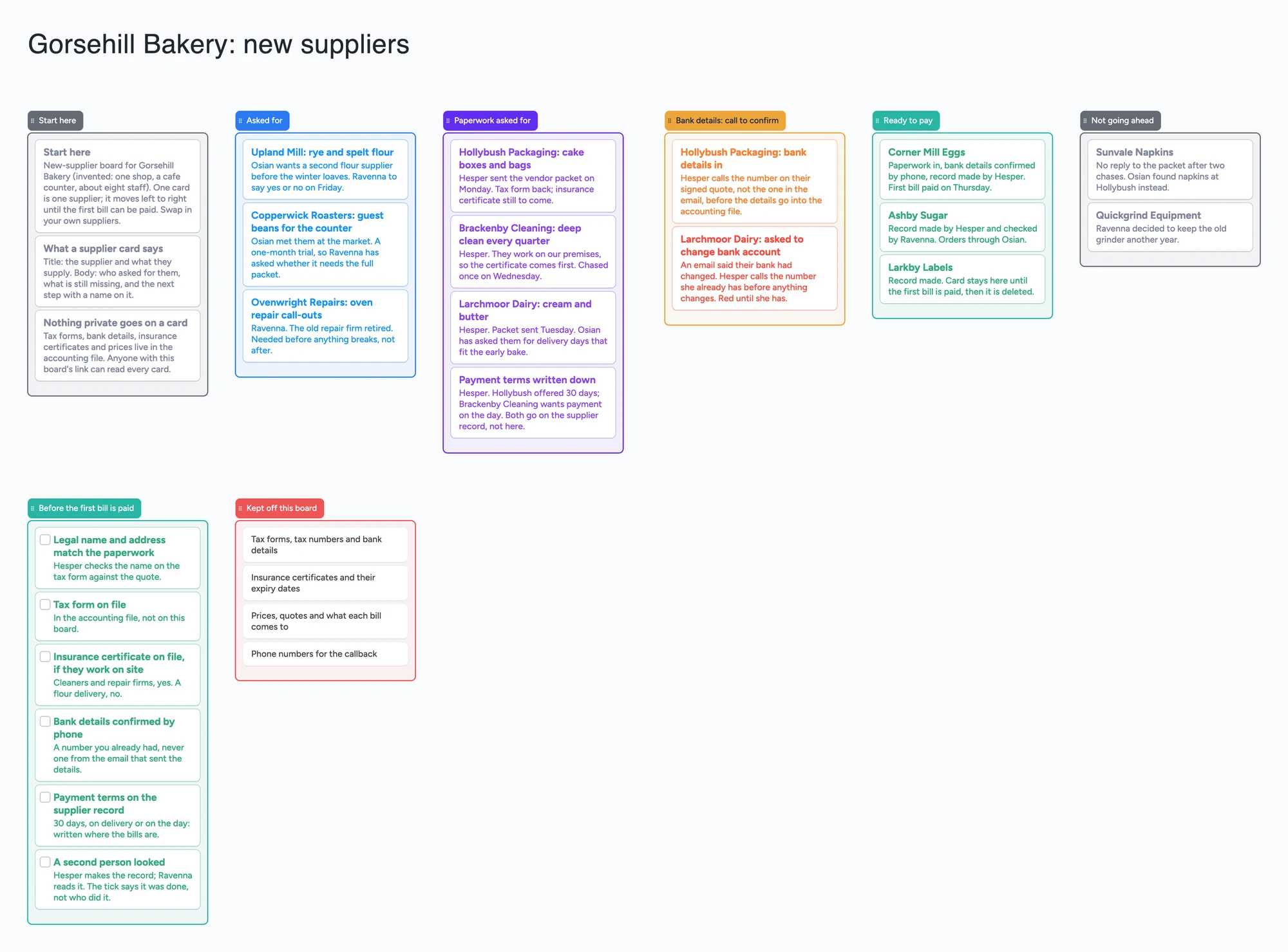
What the board shows and what it never holds
- What it shows: every supplier you are setting up, where each one is, and whose turn it is: the owner, the person who ordered them, and whoever does the books.
- What it never holds: tax forms, tax numbers, bank details, insurance certificates, prices or phone numbers. Anyone with the link can read every card.
- What it doesn't do: no approvals record, no reminders or due-date alerts, no expiry tracking for certificates, no payments. A tick shows a step is done, not who ticked it or when.
- Where it fits: a few new suppliers a month, set up by two or three people who keep asking each other where things stand.
- Room on Free: Gorsehill's board is 36 items. A free account holds 150 items in total; prices for more are in the last FAQ.
A one-page checklist, bill-pay software or this board
Most of what a small business needs from supplier onboarding is a list, a phone call and a second pair of eyes. Clyr, which sells expense and bill software, says that for a company of 15 or 50 people "a one-page checklist, a short phone call and a second person's sign-off cover most of the risk" (published November 16, 2026). Melio, a bill-pay platform, splits the job into four steps: collect and verify the details, run tax and compliance checks, set up how you pay, then approve and activate the supplier (published July 31, 2026). Both pages, read on November 27, 2026, put the result in one place: a supplier record in your accounting or bill-pay system.
So pick by what is actually slowing you down:
- If you add a supplier now and then, a printed checklist and the supplier record in your accounting software are enough. You don't need a board.
- If you want suppliers to type in their own bank details, use bill-pay software. Melio says vendors add their own bank details there, so nobody at your end handles them by hand; that is a job a shared board must never do.
- If the trouble is "where is that one up to?", because the person who orders, the person who pays and the owner each hold part of it, a board shows all the half-done suppliers at once. That is the only job this page claims.
What bookkeepers and buyers say on Reddit
Three threads. Every reply below is a single person speaking for themselves:
- "Is vendor onboarding a total mess for everyone, or is it just my company?" asked u/albie- in r/procurement (thread 1q1wpbu, January 2, 2026). u/Carbon_Creator listed their old process step by step, ending "finance asks why we don't have their W-9 yet". u/Bitter-Regret-251, at a big organisation, wrote that a simple Excel sheet "worked a million times better" than a supplier portal: "Whatever you do, don't create a complex platform." u/3alola: "Nothing reaches Finance until a checklist is complete, and one named person owns the chase." One reply comes from a company selling an onboarding tool; several others name tools they use or built in-house. Reddit shows 54 comments; the archived copy has 55, 9 of them removed or deleted.
- Tracking forms and certificates. In r/Bookkeeping (thread 16sv40l, September 26, 2023, UTC) u/PacoMahogany asked how others track W-9s and insurance certificates. u/MinionOrDaBob4Today keeps certificates as files plus "a running spreadsheet with vendor names and expiration dates", and for the tax form: "Don't set up a vendor without one." Reddit shows 13 comments; we read all 13 in an archived copy.
- When to ask. In r/Bookkeeping (thread 1fpi6vm, September 25, 2024, UTC) u/JanFromEarth asked how others request W-9s. u/five_rings: "No one gets paid until I have my paperwork", which they call the ideal, adding that putting the processes in place to support it "can be a challenge". u/Turbulent-Teacher-40 writes that for a small business the form is hard to get, and holds back the last milestone payment until the paperwork comes back. Reddit shows 17 comments; the archived copy has 19.
Our reading: the pain in all three is the chase, knowing which supplier is waiting on what and whose turn it is. That is what the board shows. Expiry dates, the forms themselves and who approved what are spreadsheet, file and accounting jobs.
What never goes on the board
A shared board is a page anyone with the link can read, and supplier onboarding is mostly private paper. Gorsehill's board has a red list called Kept off this board so nobody forgets:
- Tax forms and tax numbers. In the US that usually means the W-9 both Clyr and Melio tell you to collect. It goes in the accounting file.
- Bank details. Not even the last four digits. The card says "bank details in" or "call to confirm", nothing more.
- Insurance certificates and their expiry dates. The board can't warn you when one runs out.
- Prices, quotes and bill amounts. The board adds nothing up.
- The phone number you call to check bank details. It belongs with the supplier record you already trust.
What is left is the part worth sharing: who the supplier is, who asked for them, what is still missing and who has the next step.
Where each supplier card sits
The example is invented: Gorsehill Bakery is a made-up shop with a cafe counter and about eight staff. Ravenna owns it and says yes or no to a new supplier, Osian runs the kitchen and does most of the ordering, and Hesper does the books and makes the supplier record.
| List | Gorsehill puts a supplier here once | Example card |
|---|---|---|
| Asked for (blue) | Someone wants a new supplier | Upland Mill: rye and spelt flour. Osian wants a second flour supplier; Ravenna decides on Friday |
| Paperwork asked for (purple) | Ravenna said yes and the supplier has the packet | Brackenby Cleaning: deep clean every quarter. They work on the premises, so the certificate comes first |
| Bank details: call to confirm (orange) | Bank details arrived, or a supplier asks to change them | Larchmoor Dairy: asked to change bank account. Red until Hesper has called |
| Ready to pay (green) | The record is made and checked | Larkby Labels. Card stays until the first bill is paid, then it is deleted |
| Not going ahead (grey) | The supplier went quiet or the need went away | Quickgrind Equipment. Ravenna kept the old grinder another year |
| Before the first bill is paid (green, tick boxes) | Fixed cards: the six checks | Bank details confirmed by phone |
| Kept off this board (red) | Fixed one-line cards | Tax forms, tax numbers and bank details |
Swipe the table sideways to see every column.
Card text copied from the example. Every name and step on it is plain text someone wrote; there is no supplier, tax or bank field.
The callback card: when a supplier's bank details change
The step Clyr insists on is the phone call. Clyr's advice is to call before you pay into any new account, using "a number you already trust, such as the one on a signed contract or one you looked up yourself", and never a number taken from the email or form that sent the bank details, because if the request is fake that number reaches the thief. It says to do the same every time a supplier's bank details change, even for a supplier you have paid for years.
Gorsehill's board turns that into a list of its own, Bank details: call to confirm, so a pending call can't hide inside a longer card. When an email says Larchmoor Dairy has changed banks, Hesper adds a card there and colours it red; red means nobody pays Larchmoor until she has called the number she already had. Red is a colour Hesper picked herself; moving the card to another list leaves it red, so she switches it back after the call. The board doesn't make the call, store the number or record who answered; Clyr suggests writing down the date, the number and who confirmed it, and that note belongs with the supplier record.
Six ticks before the first bill
Gorsehill's Before the first bill is paid list is six tick-box cards that stay on the board: name and address match the paperwork, tax form on file, insurance certificate on file if they work on site, bank details confirmed by phone, payment terms on the supplier record, and a second person looked. The certificate line follows Clyr's advice to scale the checks to the risk: "A roofer on your job site gets all of it. A vendor you'll pay once, by card at the counter, needs almost none of it." Gorsehill's own reading of that: cleaners and repair firms on the premises get the full packet, a flour delivery doesn't.
Two things to know about the ticks. They are one shared checklist, not one per supplier, so Hesper unticks them before the next supplier. And a tick says only that the step is done: it records no name or time, and anyone with edit access can untick it. If you need a record of who approved a supplier, it goes in your accounting software or on the paperwork, not here.
Room for suppliers in 150 items
We counted it ourselves. A free account holds 150 items in total, counting every list and every card on every board (arrows, sections and pen strokes are free). Gorsehill's board is 8 lists + 27 cards + 1 title text box = 36. Of those, 22 are fixed (the eight lists, the title, three Start here cards, six ticks and four Kept off cards) and 14 are suppliers or notes on them.
- Deleting cards once a supplier is paid: a business adding four suppliers a month stays near 36 items.
- Never deleting: at four new suppliers a month, the board passes 150 in month 29 (36 + 4 x 29 = 152).
- The most suppliers in progress at once: 150 - 22 = 128 supplier cards, if this is the only board on the account.
Pro removes the 150-item limit; the last FAQ has the prices.
Copying it for your own shop
- Make a copy. You need a free sign-in, and the copy counts as 1 of the 5 boards a free account can hold.
- Replace Gorsehill's suppliers and people. Keep the lists; delete the cards you don't need.
- Rewrite the six ticks for what your accountant says you need before a first payment. The board gives no tax advice and neither does this page.
- Share it with the two or three people who set up suppliers: set Share to "Anyone who joins can edit"; each person signs in free to write. Send the link only to them.
- Agree what red means (Gorsehill: nobody pays this supplier yet) and write it on the Start here card.
- Delete a Ready to pay card once the first bill is paid. The supplier now lives in your accounting software, not here.
Start from the ready board
It opens in your browser in a few seconds, with nothing to install. Sign in for free when you want to save it and share it.
Questions
Is there a free supplier onboarding checklist template?
Yes. Clyr and Melio both print a short vendor onboarding checklist on their pages, and one bookkeeper on Reddit keeps a spreadsheet of suppliers. The ready board here is a shared version for two or three people: one card per supplier from asked-for to ready to pay, plus six ticks before the first bill. It holds no tax forms, bank details or prices.
Can suppliers fill in their own details on the board?
No, and they shouldn't. The board has no forms, and anyone with the link can read every card, so tax numbers and bank details must never go on it. Bill-pay software such as Melio lets suppliers enter their own bank details; use that or a paper packet, and keep the board for who has the next step.
Does the board remind me when an insurance certificate expires?
No. It sends no reminders or due-date alerts and doesn't track expiry dates. A spreadsheet of supplier names and expiry dates, sorted oldest first, is what one bookkeeper on Reddit uses.
Can the board record who approved a new supplier?
No. A tick shows a step is done but stores no name or time, and anyone with edit access can untick it. Keep approvals in your accounting software or on the signed paperwork.
What does a red card mean on the example?
Gorsehill uses red for a supplier nobody may pay yet, such as a dairy whose bank details changed and haven't been confirmed by phone. The colour is set by hand and stays when the card moves, so whoever makes the call changes it back.
Is Instaboard free?
Yes. The free plan includes 5 boards, 150 cards and items across your account (pen strokes, arrows and sections don't count), 3 images and 1 file per board, unlimited collaborators and video calls up to an hour. Pro is $5 a month billed yearly ($59.99 a year), or $7.99 monthly, and the people you invite join free.
Sources
- Clyr: What Is Vendor Onboarding? Checklist and Steps (published November 16, 2026; Clyr sells expense and bill software; read November 27, 2026)
- Melio: Vendor Onboarding Best Practices for Small Businesses (published July 31, 2026; Melio sells bill pay; read November 27, 2026)
- Reddit r/procurement: Is vendor onboarding a total mess for everyone, or is it just my company? (thread 1q1wpbu, January 2, 2026; Reddit shows 54 comments, the archived copy has 55, 9 removed or deleted; each reply is one person's view)
- Reddit r/Bookkeeping: How do you track W-9's and COI's? (thread 16sv40l, September 26, 2023 UTC; Reddit shows 13 comments, we read all 13 in an archived copy, and one comment has since been removed on Reddit and is not quoted; one person's view each)
- Reddit r/Bookkeeping: What is your process for issuing W9 requests to vendors/contractors? (thread 1fpi6vm, September 25, 2024 UTC; Reddit shows 17 comments, the archived copy has 19; one person's view each)