For two people pitching a handful of local outlets, not for a press database
A PR outreach pitch log for a small business: one card per outlet, one owner per next step
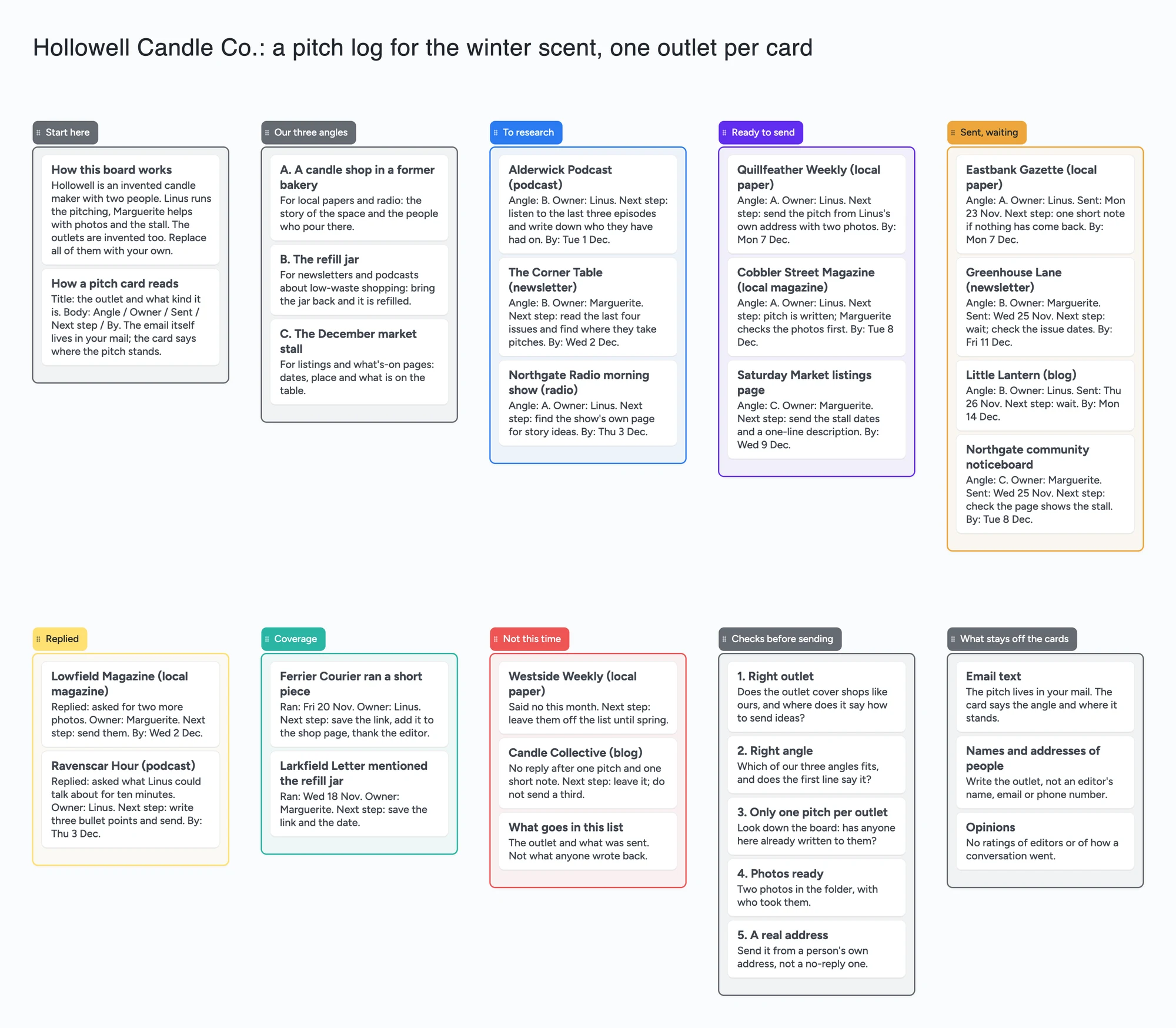
This is a pitch log, not a media database. It shows which outlet has been pitched which angle, who owns the next step and what ran, and it holds no email text, sends nothing and tracks no opens. A spreadsheet, Airtable or a PR platform does the big-list and tracking jobs better. The board below is filled in for an invented candle maker, Hollowell Candle Co., with two people, three angles and sixteen outlets, so you can read how a small round of pitching looks on one screen before you replace the names with your own.
Opens in your browser. Anyone can view; a free sign-in lets you edit.
Updated
The short version
- What it is: one screen where two people see every outlet they are pitching, which angle went to it, who owns the next step and by when. Hollowell's board uses 41 of your 150 free items.
- What it holds: the outlet and what kind it is, the angle, an owner, what was sent and when, and the next step. The pitch itself stays in your mail.
- What it is not: no contact database, no email, no open or click tracking, no reminders or due-date alerts. Dates are typed into each card.
- What stays off it: editors' names, email addresses and phone numbers, and opinions about how a conversation went.
- When to skip it: with a long contact list, several campaigns or a team that needs to see who opened what, a sheet, Airtable or a PR platform is the better home (the table below says where).
What a pitch log holds, and what stays in your mail
A pitch has three parts that want three homes. The email is written and sent in your mail. The contact details of the person at the outlet belong in a list you own and keep private. What is left is the part a small team forgets: which outlet already heard from us, with which angle, who sent it and what happens next. That part is what this board holds.
- Email text stays in your mail. A card says the angle and where the pitch stands, not what the email said.
- Names and addresses of people stay off the board. A shared board link can be read by anyone who has it, so a card names the outlet, not an editor.
- No opens or clicks. Muck Rack's help page on pitch performance (the page's stamp is October 8, 2025 UTC) describes Pitch Analytics showing who opened a pitch, clicked a link or unsubscribed; nothing on this board can show that.
- No reminders. The By date is text on the card. Someone has to read the list.
Our view: that split is the whole value. If two people only need to answer "did anyone already write to them?", a board is enough; if you need to answer "who opened it?", you need a tool that sends.
Hollowell's board, list by list
Hollowell Candle Co. and everyone in it are invented: Linus runs the pitching, Marguerite helps with photos and the stall, and the outlets are made-up names with their kind beside them (local paper, newsletter, podcast, radio, blog). A pitch card reads Angle, Owner, Sent, Next step and By. An outlet sits in one list at a time.
| List | What it holds | In Hollowell's board |
|---|---|---|
| Our three angles (grey) | The few stories you pitch, written once | "B. The refill jar" For newsletters and podcasts about low-waste shopping: bring the jar back and it is refilled |
| To research (blue) | Outlets nobody has written to yet | "Alderwick Podcast (podcast)" Angle: B. Owner: Linus. Next step: listen to the last three episodes and write down who they have had on. By: Tue 1 Dec |
| Ready to send (purple) | A pitch is written and waits for a last look | "Cobbler Street Magazine (local magazine)" Angle: A. Owner: Linus. Next step: pitch is written; Marguerite checks the photos first. By: Tue 8 Dec |
| Sent, waiting (orange) | Pitched, nothing back yet | "Eastbank Gazette (local paper)" Angle: A. Owner: Linus. Sent: Mon 23 Nov. Next step: one short note if nothing has come back. By: Mon 7 Dec |
| Replied (yellow) | Someone answered and asked for something | "Lowfield Magazine (local magazine)" Replied: asked for two more photos. Owner: Marguerite. Next step: send them. By: Wed 2 Dec |
| Coverage (green) | It ran; the next step is the link and a thank-you | "Ferrier Courier ran a short piece" Ran: Fri 20 Nov. Owner: Linus. Next step: save the link, add it to the shop page, thank the editor |
| Not this time (red) | Said no, or never answered | "Candle Collective (blog)" No reply after one pitch and one short note. Next step: leave it; do not send a third |
Swipe the table sideways to see every column.
The board's own wording. On this board the owner and the date are typed in the card text.
Four lists are not stages: Start here, the three angles, and two grey lists at the end. One holds five checks to run before anything is sent; the other, What stays off the cards, repeats the limits above.
Use it for your own round of pitching
- Open the board and clear Hollowell's outlet cards, one list at a time. Keep the list titles or rename them to your own steps.
- Write your own angles on the grey list before anyone writes a pitch; each outlet card then points to one letter.
- Add one card per outlet, the outlet and its kind in the title, then Angle, Owner, Sent, Next step and By. An outlet goes in one list at a time.
- Share it. Set Share to "Anyone who joins can edit" so the second person can move cards (new boards start view-only); each person signs in free to write. A copy takes 1 of your 5 boards.
- Read it down before every send and ask the third check out loud: has anyone here already written to them?
- Count the items. Each list and each card is 1 of your 150 free items across all your boards; arrows, sections and pen strokes don't count. Hollowell's board is 10 lists + 30 cards + 1 title text box = 41, our arithmetic, which leaves 109 on a first board.
What the media lists we read keep in a column
Hailley Griffis, whose article says the author has worked in public relations for over ten years, published "Media Contact Lists: My Template And How To Use It" (page says "Published March 23, 2023"). The suggested columns are Outlet, Contact, Beat, Email, Twitter, Covered before?, Last emailed and Author profile, in a Google Sheet; the article also says to keep a copy of your list "in a tool that you own". Cision's guide "Media List 101: Build Yours Like a Pro (With Template Examples)" (a vendor page; we saw no date on it) lists contact information, journalist details and outreach planning as the three parts of a media list, names four list types (master, press release, campaign and reactive) and links example templates in Google Sheets and Airtable.
Hollowell's board keeps two of those ideas and leaves out the rest. It keeps "covered before" as the Coverage and Not this time lists and "last emailed" as the Sent date on each card. It leaves out the contact, email and social columns on purpose, because those are about people, and a board link is a poor place for them. Our view: a candle maker with sixteen outlets does not need a list type for each campaign; a firm with hundreds of contacts does, and a sheet is where that goes.
How one small team asked about tracking pitches
In an r/PublicRelations thread ("How do you track pitches across teams?", posted May 5, 2022 UTC by u/KYGC2160; Reddit shows 8 comments and we read 8 in an archived copy), the poster describes working across many accounts at a B2B agency with a pitching sheet that is laborious and that nobody sticks to. One reply says that for big announcements their team uses a Google Sheet kept by one point person, and that Muck Rack has multi-account features showing which reporters were sent which pitch by which person. Another suggests an email automation tool and says it costs $39 with a discount (no billing period is given). A third says Monday Calendar or Excel or Google Sheets. The poster answers that the team uses sheets but most forget to use them. The last reply, posted nine days later by u/armorofhope527, says their CEO and founder came up with Propel, a pitching product: a vendor's reply, not a user's. These are single people's accounts from 2022, not a survey, and the prices are theirs.
The poster says the sheet is not kept up: "no one seems to stick to it" and "most forget to use it". Hollowell's board does not solve that by itself; it puts an owner and a By date on every outlet card, and its Checks list starts with "has anyone here already written to them?".
Where a sheet, Airtable or a PR platform does this better
| Tool | What its own page says (read November 26, 2026) | When it wins over this board |
|---|---|---|
| Google Sheets or Excel | The Griffis article's template is a Google Sheet with eight columns; Cision's examples include two Google Sheets | You have dozens of outlets and want columns, sorting and a filter by beat |
| Airtable | Its PR outreach template page says the template stores information on media outlets, writers and editors, and offers a kanban view and a calendar view to track publication dates | You want contact records linked to pitches and a view by date; this board has no fields or linked records |
| Muck Rack | Its help page (stamp October 8, 2025 UTC) describes Pitch Analytics, Coverage Reports and Dashboards; replies from journalists are not logged automatically, but can be logged by forwarding the email to an address it gives | You send pitches from the platform and want opens, clicks and coverage reports |
| Instaboard | One shared board; lists are stages, owners and dates typed by hand; no email, tracking or alerts | Two people share a small round of pitching and want to see who owns each next step on one screen |
Swipe the table sideways to see every column.
Each cell is the page's own wording or ours, read on the date above. Vendor claims are the vendor's. We did not read any of these tools' pricing pages.
When a pitch runs, and when the round is over
A Coverage card holds three next steps, in this order: save the link, add it to your own page and thank the person. When the round is done, move what you want to keep into your own records and archive or delete the outlet cards, because they count toward your 150 items and anyone with the link can still read them.
- No history of who changed what. We found no history panel on the board; the Sent date is only what someone typed.
- No way to see who opened a pitch. That needs the tool that sent it.
- Not built for volume. With a long contact list, a sheet or a platform is the better home.
Start from the ready board
It opens in your browser in a few seconds, with nothing to install. Sign in for free when you want to save it and share it.
Questions
Is there a PR outreach template for a small business?
Yes, in several forms: spreadsheets, Airtable bases and PR platforms. This one is a ready board with a list for each step from research to coverage, three angles written once, and an owner and a dated next step on each outlet card. It is built for a round of a dozen or so outlets and two people, not for a contact database.
What should a media list or pitch log include?
The sources we read differ. The Griffis article's template has outlet, contact, beat, email, Twitter, covered before, last emailed and author profile; Cision's guide names contact information, journalist details and outreach planning. This board keeps only the outlet, angle, owner, sent date and next step, and leaves people's details in your own list.
Does the board store journalists' emails or the pitch text?
No. Anyone with the link can read a shared board, so Hollowell's cards name the outlet, not an editor, and the email stays in your mail. The card says the angle and where the pitch stands.
Can it show who opened my pitch?
No. It sends nothing and tracks nothing. A tool that sends the pitch is the place for that; Muck Rack's help page describes opens, clicks and unsubscribes in its own Pitch Analytics.
How do I avoid pitching the same outlet twice?
Give each outlet one card and keep it in one list at a time. Before every send, read the board down and ask whether anyone has already written to that outlet. Our suggestion, not a rule from any page we read.
Is Instaboard free?
There is a free plan: 5 boards, 150 cards and items across your account (pen strokes, arrows and sections don't count), and 3 pictures and 1 file per board. Anyone with the link can read a board; writing on it takes a free sign-in. Pro removes the item limit and adds invite-only boards: $5 a month billed yearly ($59.99 a year), or $7.99 monthly.
Sources
- Hailley Griffis: "Media Contact Lists: My Template And How To Use It" (page says "Published March 23, 2023"; a personal blog; read November 26, 2026)
- Cision: "Media List 101: Build Yours Like a Pro (With Template Examples)" (no page date seen; a vendor guide; read November 26, 2026)
- Muck Rack Help Center: "Ways to Track Pitch Performance" (page stamp October 8, 2025 UTC, which a browser set to China time shows as October 9; a vendor page; read November 26, 2026)
- Airtable: "PR outreach template" (no page date; a vendor page; read November 26, 2026)
- r/PublicRelations: "How do you track pitches across teams?" (posted May 5, 2022 UTC by u/KYGC2160; replies by u/SeantotheRescue, u/WhatIsGoingOn1998567, u/packed_underwear, u/armorofhope527; Reddit shows 8 comments, we read 8 in an archived copy, November 26, 2026)