For a small business where HR, IT and the manager are three different people
An employee offboarding board for a small team: one owner per task
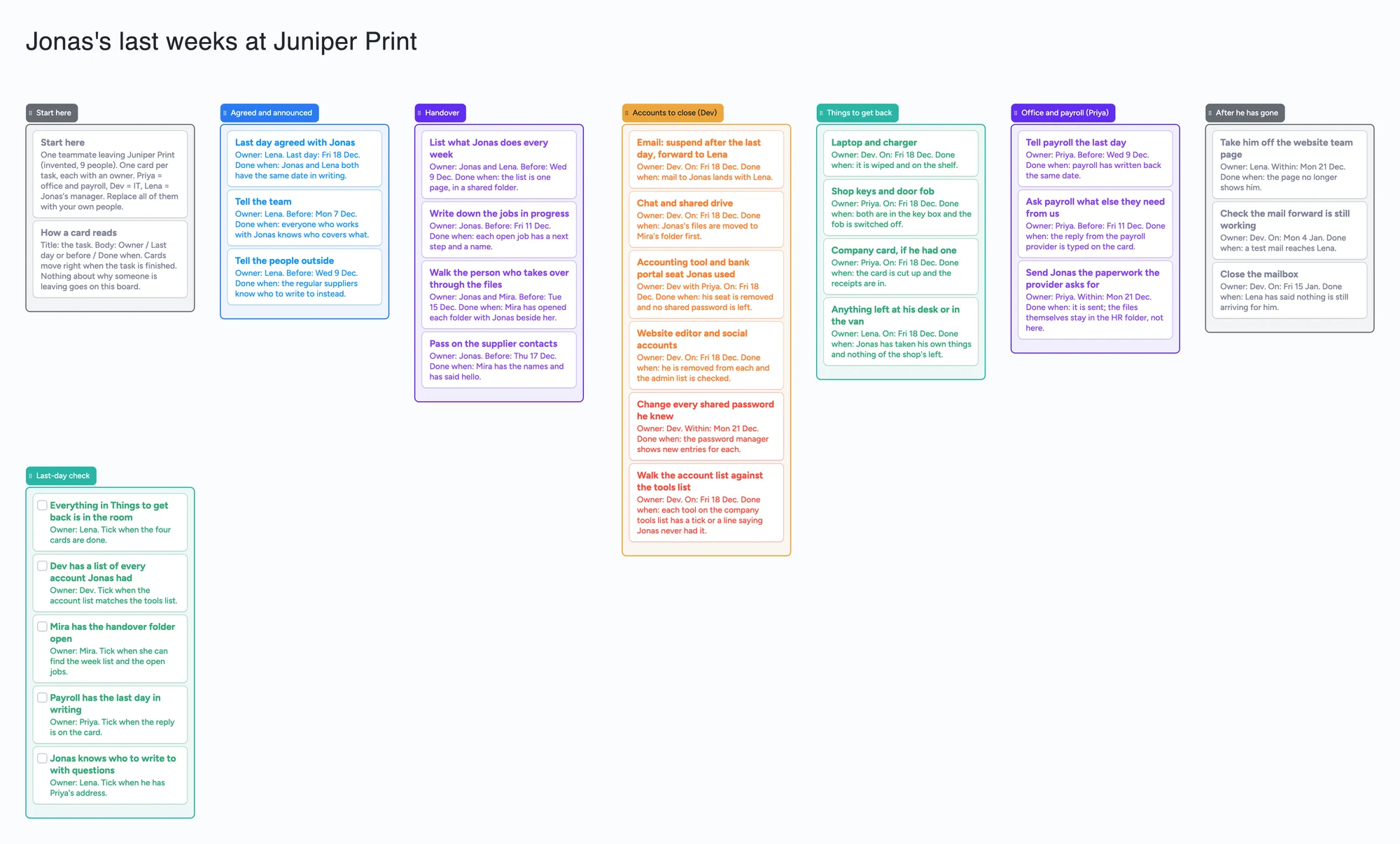
We make Instaboard, an online board. This page gives you an offboarding board already laid out and filled in for an invented teammate, Jonas, who is leaving a nine-person print shop: Agreed and announced, Handover, Accounts to close, Things to get back, Office and payroll, After he has gone, and a Last-day check list. Every task card names who owns it. It is a board you read by eye. It does not send forms, revoke an account, check a payroll rule or remind anyone. If one person does the whole job, a printed checklist is enough, and the first section says so.
Opens in your browser. Anyone can view; a free sign-in lets you edit.
Updated
The short version
- What it is: one screen for the people who each own a piece of someone's last weeks: the manager (handover), whoever runs IT (accounts), whoever runs the office (things back, payroll). Jonas's board uses 39 of your 150 free items.
- Who sees it: one link, one audience. Anyone who joins can view the board, so it holds task titles and first names only. Reasons for leaving, pay, health and performance stay off it.
- What it is not: no forms, no account switch-off, no payroll or legal rules, no exit interview notes, no reminders or due-date alerts. Dates and owners are typed in each card.
- When to skip it: if one person does every task, a printed checklist is enough (first section).
- Free plan: 5 boards, 150 items and 3 pictures per board. Pro removes the item limit; the last FAQ has the prices.
When a printed checklist is enough
Our reading of Google's suggestions on November 25, 2026 for four offboarding heads: they show word, excel, form, email and sample variants and none with the word board, so most searchers look like they want a file. If you run a three-person shop and you do every task yourself, a printed list on the desk does the job and a board adds nothing.
A board starts to help when the tasks belong to different people and each of them needs to see where the others are. At Juniper Print that is three people around one leaver: Lena (his manager) runs the handover and the announcements, Dev runs the accounts and the laptop, Priya runs the keys, the card and the payroll line. None of them can see the others' to-do lists. The board is the one place all three look.
What stays off a link board
A board you share by link can be opened by anyone who has the link, so treat it like a list taped to a shop window. Jonas's board holds task titles, first names and dates. It does not hold:
- Why someone is leaving, whether they resigned, were let go or retired.
- Pay, leave balances, payout amounts or bank details. Priya's card says "ask payroll what else they need"; the answer is typed as a plain line, and the figures live in your payroll provider.
- Health, performance or conflict notes. An exit interview needs a private document, not a card.
- Passwords. The Accounts to close (Dev) cards say "change every shared password" and never print one.
- Anything under a legal or HR duty in your country. Final pay and paperwork rules differ by place; this page is not legal advice and the board does not know your rules.
Invite-only boards are a Pro feature. On the free plan a link is the only way to share, so keep the board to tasks you would be happy for a stranger to read.
Jonas's board, list by list
The example is invented: Jonas, Lena, Dev, Priya and Mira work at a nine-person print shop and every name is made up. Task cards read Owner, a date and Done when; the Last-day check cards read Owner and Tick when.
| List | Whose it is | In Jonas's board |
|---|---|---|
| Agreed and announced (blue) | Lena | "Last day agreed with Jonas" Owner: Lena. Last day: Fri 18 Dec. Done when: both have the same date in writing |
| Handover (purple) | Jonas and Lena, then Mira | "List what Jonas does every week" Before: Wed 9 Dec. Done when: the list is one page, in a shared folder |
| Accounts to close (Dev) (orange) | Dev | "Chat and shared drive" On: Fri 18 Dec. Done when: Jonas's files are moved to Mira's folder first |
| Things to get back (green) | Dev, Priya and Lena | "Shop keys and door fob" Owner: Priya. Done when: both are in the key box and the fob is switched off |
| Office and payroll (Priya) (purple) | Priya | "Tell payroll the last day" Before: Wed 9 Dec. Done when: payroll has written back the same date |
| After he has gone (grey) | Lena and Dev | "Check the mail forward is still working" On: Mon 4 Jan. Done when: a test mail reaches Lena |
Swipe the table sideways to see every column.
The board's own wording. Dates and owners are typed by hand; the board has no owner or status field.
The Last-day check list holds five tick-box cards, each naming its owner in the body. A tick carries no name or time, so a ticked box only means somebody ticked it.
Who does what: three checklists that already exist
We read three public checklists on November 25, 2026 to see how other places split the tasks. None is for a nine-person shop, and none prints a date on the page.
- Ohio State's CVM manager checklist opens by saying managers are responsible for processing an employee's departure and getting equipment back before the last day. Its numbered tasks include a VIS Exit Form once the resignation is approved, a separate building access request that routes to IT, Facilities and Finance, collecting keys, sending an announcement of who to contact, and moving direct reports.
- DePaul's offboarding checklist for managers has the manager submit a termination request in its HR system before the last day, tell the remaining staff, collect university property (keys, phone, laptop, ID cards, files) and ask its network admins to transfer any departmental IT resources the employee managed. Exit interviews there are run by an outside firm.
- Asana's employee offboarding template page says the manager and HR "usually handle offboarding" and that it is worth checking what IT and finance need. It also lists "delaying system access revocation" among common mistakes and says to make IT access revocation one of the first tasks.
Our reading, not theirs: in the two university checklists the manager's list is long and other teams own single lines. Jonas's board gives each of those lines to a named person instead of leaving them inside the manager's list.
The forgotten login: what people on r/startups say
An r/startups thread from January 2018, "How do you usually deal with employee's off-boarding?" (77 points; Reddit shows 42 comments, we read 45 in an archived copy), starts with a founder who forgot one service when two people left and found a year later that one of them still had access to the company's AWS account. It is an old thread and each reply is one person's view.
- u/RaleighIsTheBest suggests Okta with SAML sign-in for the services, so removing one account removes the rest. u/Hanse00 says to use a single account system that controls everything else, and u/RonSijm says to enable OAuth sign-in and disable that one account.
- u/UpTheDownEscalator suggests a password manager such as LastPass or 1Password so a team can use services without being given the passwords.
- u/_chance keeps a task list in their project management software for onboarding and reverses it for offboarding.
- u/TofuTofu writes "Checklists are your friend", and u/cliffregis, who worked in HR, says they used a checklist, "But now a saml provider could be used these days."
- u/KylesBrother says to write the procedure, make a checklist and name one person to keep it up to date and another to run it.
- u/RoiDeLimbourg says the easy way is a checklist and a process, and that logging the steps the first time makes the next one easier.
- u/smhsmhsmh1 disagrees with the single sign-on advice: "Really no need for the added complexity and cost of SSO." Their answer is to use whatever system you already track projects in, and create one for offboarding with a checklist of which tools get shut down, in what order, and by whom.
The replies split. Several suggest cutting the number of places that need switching off; smhsmhsmh1 says a written list is enough. In our view that is a different job from this board, which only helps with the part both camps mention: a written list, with a named owner, that someone walks against the list of tools you pay for. That is why Jonas's board has a card that says exactly that, owned by Dev.
Run it with your own people
- Open the board and delete Jonas's cards one list at a time. Keep the list titles; rename them if your stages differ.
- Write down the people first. One line on the Start here card: who is manager, who is IT, who runs the office, who takes the work over.
- Put the real tasks in. One card each, with Owner, a date and Done when. Skip a task if nobody owns it yet; an unowned card is how things get lost.
- Do the account list as a walk, not a memory test. List every tool your company pays for, then give each a tick or a line saying the leaver never had it.
- Share it. Set Share to "Anyone who joins can edit" so Lena, Dev and Priya can move cards; each person signs in free to write.
- Fix the last-day check. Keep the five tick cards or change them, and pick one person to look at it on the last day.
- Make a fresh copy for each departure. Delete finished boards when the last card is done.
Where something else does this better
| Tool | What its own page says (read November 25, 2026) | When it wins over this board |
|---|---|---|
| Asana employee offboarding template | A guide to making an offboarding checklist template in six steps in Asana; mentions attaching documents to the checklist and checking with IT and finance. Pricing not read | You already run your work in Asana and want the checklist beside it |
| University manager checklists (OSU, DePaul) | Long manager checklists that route to IT, finance and HR through the university's own forms and systems | You are a large employer with an HR system, forms that go to IT and finance, and compliance staff |
| Single sign-on or an identity provider | Not read as a product. The r/startups thread above recommends it for closing many logins at once | You pay for many cloud tools and want one switch instead of a list |
| Google Docs or Sheets | Not read | One person does everything, or you want sums and filters |
| Instaboard | One shared board; lists are stages, owners and dates typed by hand; no forms, switch-off, payroll rules or alerts | A few people each own lines of the same departure and want to see them on one screen |
Swipe the table sideways to see every column.
Each cell is the page's own wording, read on the date above. Where no page was read, the cell says so.
How many departures before 150 items
Our arithmetic. Each list and each card is 1 of your 150 free items across all your boards; arrows, sections and pen strokes don't count. Jonas's board is 8 lists + 30 cards + 1 title text box = 39. Three departures open at once come to 3 × 39 = 117; a fourth makes 156, over 150. Deleting a finished board frees its items; keeping them does not.
Each fresh copy also takes 1 of your 5 free boards. The fourth open departure is where the 150 items bite; the 5-board limit comes after.
What stays a person's job
- No account switch-off. Nothing here removes a login; Dev does that in each tool and ticks the card.
- No forms or approvals. There is no request that routes to IT or finance, and nobody signs anything here.
- No payroll or legal rules. The card holds your provider's answer typed by hand; the board knows no final-pay or notice rule.
- No reminders or due-date alerts. A date in a card is text. The Last-day check is a habit, and a tick carries no name or time.
- No exit interview notes and no private details. Keep them in a document only the right people can open.
- One link, one audience. Anyone with the link sees every card; invite-only boards are a Pro feature.
Start from the ready board
It opens in your browser in a few seconds, with nothing to install. Sign in for free when you want to save it and share it.
Questions
Is there a free employee offboarding template?
Yes, in several forms. Asana has a guide to building one in its own app, and Word and Excel versions turn up in Google's suggestions. The ready board here is an offboarding template on a shared board, with a list for handover, accounts, things to get back and payroll, and an owner on every task card. It is a board you read and move cards on; it does not send forms or switch off logins.
Who should own the offboarding checklist?
It depends on the size of the team. In the university checklists we read the manager owns most of it and other teams own single lines. On this board every task card names one owner, so a task without a name is easy to see. If you are the only person doing the work, a printed checklist is enough.
What should never go on a shared offboarding board?
Why the person is leaving, pay or leave amounts, bank details, health or performance notes and passwords. Anyone with the link can read a shared board, so keep only task titles, first names and dates, and put the private parts in a document with limited access.
Does the board close accounts or collect equipment?
No. It shows who owns each account and each item and whether the card is done. A person closes the login or takes back the laptop and then moves the card. Nothing here checks that it happened.
Can I use it for more than one departure at a time?
Yes, with a fresh copy for each person. Each copy takes 1 of your 5 free boards and its own items against the 150. Three of Jonas's boards open at once come to 117 items.
Is Instaboard free?
There is a free plan: 5 boards, 150 cards and items across your account (pen strokes, arrows and sections don't count), and 3 pictures and 1 file per board. Anyone with the link can read a board; writing on it takes a free sign-in. Pro removes the item limit and adds invite-only boards: $5 a month billed yearly ($59.99 a year), or $7.99 monthly.
Sources
- r/startups: "How do you usually deal with employee's off-boarding?" (posted January 2018 by u/m0utinh0, 77 points; replies by u/RaleighIsTheBest, u/Hanse00, u/RonSijm, u/UpTheDownEscalator, u/_chance, u/TofuTofu, u/cliffregis, u/KylesBrother, u/smhsmhsmh1, u/RoiDeLimbourg; Reddit shows 42 comments, we read 45 in an archived copy, November 25, 2026)
- Asana: Employee Offboarding Template: Checklist + Steps (page title says [2026]; no date printed in the text; read November 25, 2026)
- Ohio State University CVM Human Resources: Manager Offboarding Checklist (no date printed; read November 25, 2026)
- DePaul University Human Resources: Offboarding Checklist for Managers (no date printed; read November 25, 2026)