For the owner, the person who runs the work and whoever looks after IT, bringing in one freelancer
Contractor onboarding for one freelancer, on a board the two or three of you share
We make Instaboard, an online board for planning with other people. Hiring a freelancer for one project is a smaller thing than hiring an employee, but it still passes through two or three hands: the person who owns the company, the person who runs the work and the person who looks after IT. This page gives you that hand-off laid out and filled in for an invented project. Thornby Print Co, a print shop of six, brings in Ludmila, a freelance web developer, for eight weeks to rebuild its order page. Henrike owns the shop, Bram looks after IT and the website host, Tiberius runs the jobs. The board has nine lists, from Start here to a red list of what never goes on it. Open it, swap in your own people and send the link on. It shows who has done their piece and what is still open. It is not a contract, a tax form or a legal check, and it sends no reminders. If you alone do every step, a short note is enough; the first section says when.
Opens in your browser. Anyone can view; a free sign-in lets you edit.
Updated
The short version before you copy it
- Who it is for: two or three people who each hold a piece of one freelancer's project. The example is 45 of your 150 free items. If one person does every step, a short note or the email thread is quicker; the next section says when.
- What it does: it puts the hand-offs for one project on one page: what is agreed before she starts, which access she gets and when it ends, the kickoff, the weekly call, the first thing she shows and the end. Anyone you give edit access to can move a card or tick a box.
- What it isn't: it isn't a contract, a tax form, HR software or a legal check. It collects and signs nothing, and it sends no reminders or due-date alerts. A date inside a card, such as Friday of week 8, is text you typed.
- Ticks: Before she starts, Access and When it ends have tick boxes. Nothing stores who ticked or when, so agree who ticks what and say so on the call.
- Keep off it: her rate, the agreement, her tax form, bank details and passwords. A board is shared by link. The example only says that the agreement and the form are with the owner.
- Free plan: 5 boards, 150 items, 3 pictures per board. Copying the board takes 1 of your 5 boards. Writing on it needs a free sign-in. New boards start with Anyone who joins can view.
A note or a board: who is holding which piece
Most of what guides say about a contractor's start is paperwork, and the board does none of it. What it can hold is the part that falls between people: who has said yes to the scope, who set up which access and who is waiting on whom. If you alone agree the scope, set up the access and run the weekly call, write it in one note and skip the board.
- One person does it all: one note, or the email thread with the freelancer.
- You need forms collected, an agreement signed or the worker's status checked: that is for the owner, an accountant or a tool built for it. The board makes no accounts and holds none of it.
- Two or three people each hold a piece of one project: this board. The shared part is who has finished their piece and what is still open a week before the start.
Thornby's eight weeks, one list at a time
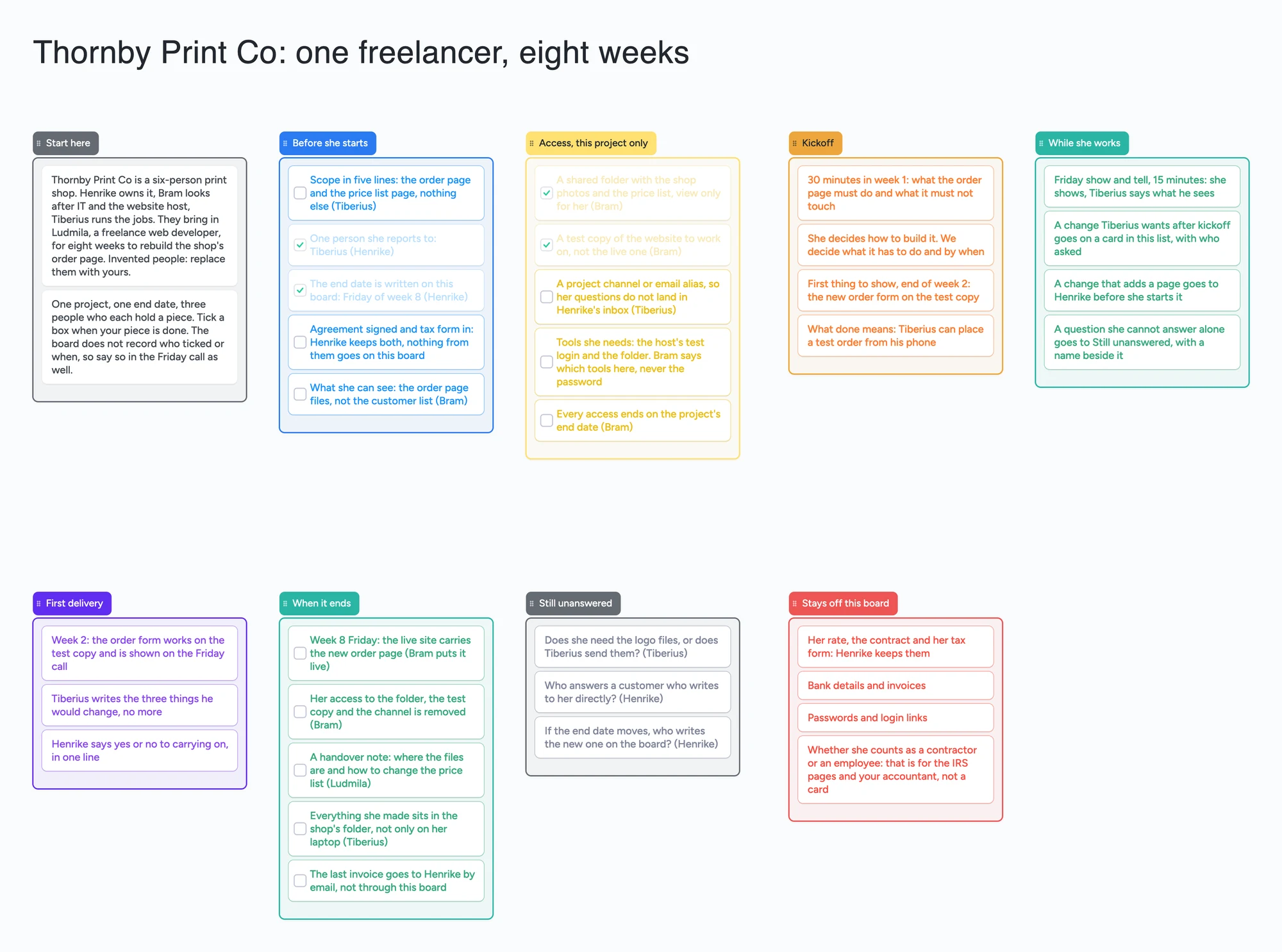
Thornby, Ludmila and the three colleagues are made up. The nine lists run across the top row and then the bottom.
- Start here. Two grey cards: who the four people are and what the project is, and how the board is used, including that ticks carry no name or time.
- Before she starts. Five blue cards with tick boxes, two ticked: the scope in five lines, one person she reports to, the end date written on the board, the agreement and tax form (kept by Henrike, nothing from them on the board) and what she can see.
- Access, this project only. Five yellow cards with tick boxes, two ticked: a view-only shared folder, a test copy of the website to work on, a project channel or email alias, the tools she needs (Bram writes which, never a password) and a last card that every access ends on the project's end date.
- Kickoff. Four orange cards: a 30-minute call in week 1, who decides what, the first thing to show at the end of week 2 and what done means.
- While she works. Four green cards: a 15-minute Friday show and tell, where changes Tiberius wants go, that a change adding a page goes to Henrike, and where a question she cannot answer alone goes.
- First delivery. Three purple cards: the order form working on the test copy in week 2, the three things Tiberius would change and Henrike's yes or no to carry on.
- When it ends. Five green cards with tick boxes, none ticked yet: the new page goes live, her access is removed, a handover note, the files in the shop's folder and the last invoice by email.
- Still unanswered. Three grey cards with a name beside each: the logo files, who answers a customer who writes to her directly, and who writes a new end date if it moves.
- Stays off this board. Four red cards: her rate and contract, bank details and invoices, passwords and login links, and whether she counts as a contractor or an employee.
Every day and week above is text on a card. Moving a card changes nobody's calendar.
Write the end date before the first access
All three guides we read tie access to the end of the engagement, and the board's Before she starts and Access lists follow that. Each page was read in a browser on November 27, 2026; the dates below are the ones the pages print.
- KORE1 (a staffing firm; the page shows August 31, 2026 and Last updated: October 29, 2026) gives a hiring manager's schedule of access ten days before the start, equipment seven days before and the scope settled three days before, with a named internal owner. It writes the offboarding date beside each access, and describes a contractor's VPN certificate that was still active 14 months later.
- Checkflow (a checklist-software vendor; the page shows no date) puts an end date on day one beside the scope of work and the IP assignment, and says that running a contractor through employee onboarding can undermine the self-employed status.
- FirstHR (an HR-software vendor; Updated October 27, 2026) is built mostly around paperwork, a W-9, a 1099-NEC and the risk of misclassification, but its checklist also gives a contractor access for the specific engagement and an access-expiry line tied to the contract end date.
That is why Thornby's board holds the end date as its own tick card in the first list, and ends the access list with a card saying every access ends on that date. The board does not end anything: Bram removes her access himself and ticks the card in When it ends. The VPN example is the argument for ticking that card last and not skipping it.
What owners say in two small-business threads
Each reply is one person's account, not a rule. Reddit was blocked in our browser, so we read an archived copy and print both counts.
In r/smallbusiness, How do you handle onboarding new contractors/clients without re-explaining everything from scratch? (OP u/Extension_Value3336, July 15, 2026 UTC; Reddit shows 19; the archived copy has 20 entries, 3 removed, including the poster's 2 replies and 1 AutoModerator note), u/Bright_Relativ wrote that for contractors they keep the stuff to know once apart from the stuff to do in order, and add how decisions are made here plus two or three examples of good work against bad. u/AWGV_G, who said they ran a small web agency, described a short kickoff checklist plus short recordings for the parts people kept asking about, such as where files go and what counts as done, and, in a later reply to the poster, said it saved about 20 minutes per meeting and another 30 to 45 minutes of follow-up after meetings. u/Scary_Web wrote that the steps worth writing down are the boring ones: who approves what, where files live, which fields are mandatory and who owns the next step. u/VirtualMemory9196 replied that the post itself was marketing for a product; we did not check that, and we do not rely on the post, only on the replies about practice.
In r/smallbusiness, Questions about onboarding a freelancer/contractor (OP u/ottosucks, March 25, 2025 UTC; the archived copy has 3 comments, one the poster's own reply and one an AutoModerator note about the sub's question-and-answer rules), the owner asks whether they need payroll software for one as-needed contractor. u/LeadForTomorrow answered that you can do without it, that contractors fill out a W-9 before any work and that the forms and directions are on the IRS website. That one account is the whole tax answer in the thread, and it is a reason this board stops at the edge of the paperwork.
Our view: the first thread is about the hand-offs, the second about the forms. The board is for the first kind. It does not replace anything in the second.
Other places to run a freelancer's start
Pages read November 27, 2026 and liable to change. A date appears below only where the page itself shows one, and no vendor's plan limits were read.
| Source | What the page says | Better for |
|---|---|---|
| FirstHR, Contractor Onboarding: Checklist and Compliance (Updated October 27, 2026) | A four-phase checklist built on a W-9, a 1099-NEC and the misclassification risk | An owner who wants the paperwork steps in one place. A vendor's own page |
| KORE1, Contractor Onboarding Checklist for Hiring Managers (Aug 31, 2026; Last updated October 29, 2026) | Access, equipment and scope on a countdown before the start, a named internal owner, an offboarding date beside each access | A manager at a larger company with IT and a recruiter. A staffing firm's own page |
| Checkflow, Contractor Onboarding Checklist Template (no date printed) | An end date on day one, a scope of work and IP assignment, and a warning against employee onboarding for contractors | A checklist tool for repeated starts. A vendor's own page |
| Clustdoc, Independent contractor onboarding checklist (no date printed) | A workflow for collecting tax forms, agreements and project details | Collecting and storing documents from the contractor. A vendor's own page |
| Remote, How to onboard independent contractors (February 5, 2025) | Ten steps, the first being to create a contractor onboarding checklist | A written guide to the steps. A vendor's own page |
| IRS, Independent contractor (self-employed) or employee? (Page Last Reviewed or Updated: 19-May-2026) | The agency's own page on how to tell the two apart | The first place to read about status. Not a checklist |
| A short note or the email thread | Not read for this page | One person doing every step |
| Instaboard board | 5 boards, 150 items, 3 pictures per board on the free plan | Two or three people who need one plan for one project that they can all see and tick |
Swipe the table sideways to see every column.
Pages read November 27, 2026 in a browser or an archived copy: firsthr.app, kore1.com, checkflow.io, clustdoc.com, remote.com, irs.gov. Our wording, not theirs.
Counting items: one freelancer, then more
On the free plan 150 items are shared across every board you own. A list is 1 item, a card is 1 and the title text box is 1; arrows, sections and pen strokes aren't counted. Our arithmetic for freelancers:
- As built: 9 lists + 35 cards + 1 title = 45.
- A second freelancer on a copy: 45 + 45 = 90, and the copy takes 1 of your 5 boards.
- A third: 135. A fourth would be 180, which is over 150.
- With Pro, the 150-item limit is removed.
Left off the board, and who keeps it
- Her rate, the agreement and her tax form. The owner keeps them. The board says where, not what.
- Bank details and invoices. The last invoice goes by email.
- Passwords and login links. The IT card says which tools, never how to sign in.
- Whether she counts as a contractor or an employee. That is a legal and tax question, not a card. The IRS has a page on it, Independent contractor (self-employed) or employee?, which showed Page Last Reviewed or Updated: 19-May-2026 when we read it; start there and ask your accountant. Nothing on this page is advice on it.
- Alerts of any kind. None are sent, no reminders and no due-date alerts. Friday of week 8 is typed text, so one of you has to look at the board that week.
- A record of who ticked what. Anyone with edit rights can tick or untick, and nothing notes the person or the time. Say it aloud on the Friday call.
- Privacy. The link is the lock: a new board reads Anyone who joins can view, so whoever holds the link can read it. Switch to Anyone who joins can edit only for the two or three who write.
Making it yours in five steps
- Open the board, and sign in for free the first time you want to type. Swap Thornby and the four names for your own.
- Fill Before she starts first, and write the end date before anything else. The access list can only be right once the scope and the end date are written down.
- Put one name on each card, in its text, and park anything undecided in Still unanswered.
- Share it. Choose Anyone who joins can edit for your own two or three, or leave view for a reader. Each writer signs in free. Decide whether the freelancer gets the link at all; Still unanswered is written for the team.
- Next project: make a fresh copy. Ticks come with it, so clear them, then change the name, the scope and the dates.
Start from the ready board
It opens in your browser in a few seconds, with nothing to install. Sign in for free when you want to save it and share it.
Questions
What do the nine lists on the example board hold?
One hand-off each: what is agreed before she starts, the access for this project only, the kickoff, the weekly call, the first delivery, the end, the questions nobody has answered and what stays off. Every card is one line. Three lists have tick boxes. None holds a rate, an agreement, a tax form or a password.
Can this board stand in for a contract or a tax form?
No. It collects and signs nothing, and it says nothing about whether someone is a contractor or an employee. That belongs to the owner, an accountant or a tool built for forms. The board is for the few people who share one freelancer's project and need to see what is still open.
Who reminds us to switch her access off at the end?
You do. The board sends no reminders or due-date alerts. The end date is text you typed, and one card in the access list says every access ends on it. Someone has to open the board, so put the real date in your calendars as well.
Does the freelancer get to see the board?
You decide. New boards start with Anyone who joins can view, so anyone with the link can read it. Still unanswered and Stays off this board are written for the team, so think before you send her the link.
How many freelancers fit in the free plan?
The example is 45 items. A copy for a second freelancer makes 90 and a third 135; a fourth would be 180, over the 150 limit. Each copy also uses 1 of your 5 free boards (our arithmetic).
Is Instaboard free?
Yes. The free plan includes 5 boards, 150 cards and items across your account (pen strokes, arrows and sections don't count), 3 images and 1 file per board, unlimited collaborators and video calls up to an hour. Pro is $5 a month billed yearly ($59.99 a year), or $7.99 monthly, and the people you invite join free.
Sources
- r/smallbusiness: How do you handle onboarding new contractors/clients without re-explaining everything from scratch? (OP u/Extension_Value3336, July 15, 2026 UTC; replies are single accounts; Reddit shows 19; the archived copy has 20 entries, 3 removed, including the poster's 2 replies and 1 AutoModerator note; November 27, 2026)
- r/smallbusiness: Questions about onboarding a freelancer/contractor (OP u/ottosucks, March 25, 2025 UTC; the archived copy has 3 comments, including the poster's own reply and 1 AutoModerator note; November 27, 2026)
- FirstHR (a vendor's own page): Contractor Onboarding: Checklist and Compliance (Updated October 27, 2026; read November 27, 2026)
- KORE1 (a staffing firm's own page): Contractor Onboarding Checklist for Hiring Managers (August 31, 2026, Last updated: October 29, 2026; read November 27, 2026)
- Checkflow (a vendor's own page): Contractor Onboarding Checklist Template (no date printed; read November 27, 2026)
- Clustdoc (a vendor's own page): Independent contractor onboarding checklist (no date printed; read November 27, 2026)
- Remote (a vendor's own page): How to onboard independent contractors: an expert guide (February 5, 2025; read November 27, 2026)
- IRS: Independent contractor (self-employed) or employee? (Page Last Reviewed or Updated: 19-May-2026; read November 27, 2026)