For two or three founders running one raise, not for a CRM
A fundraising pipeline for a small founding team: one card per investor, one dated next step
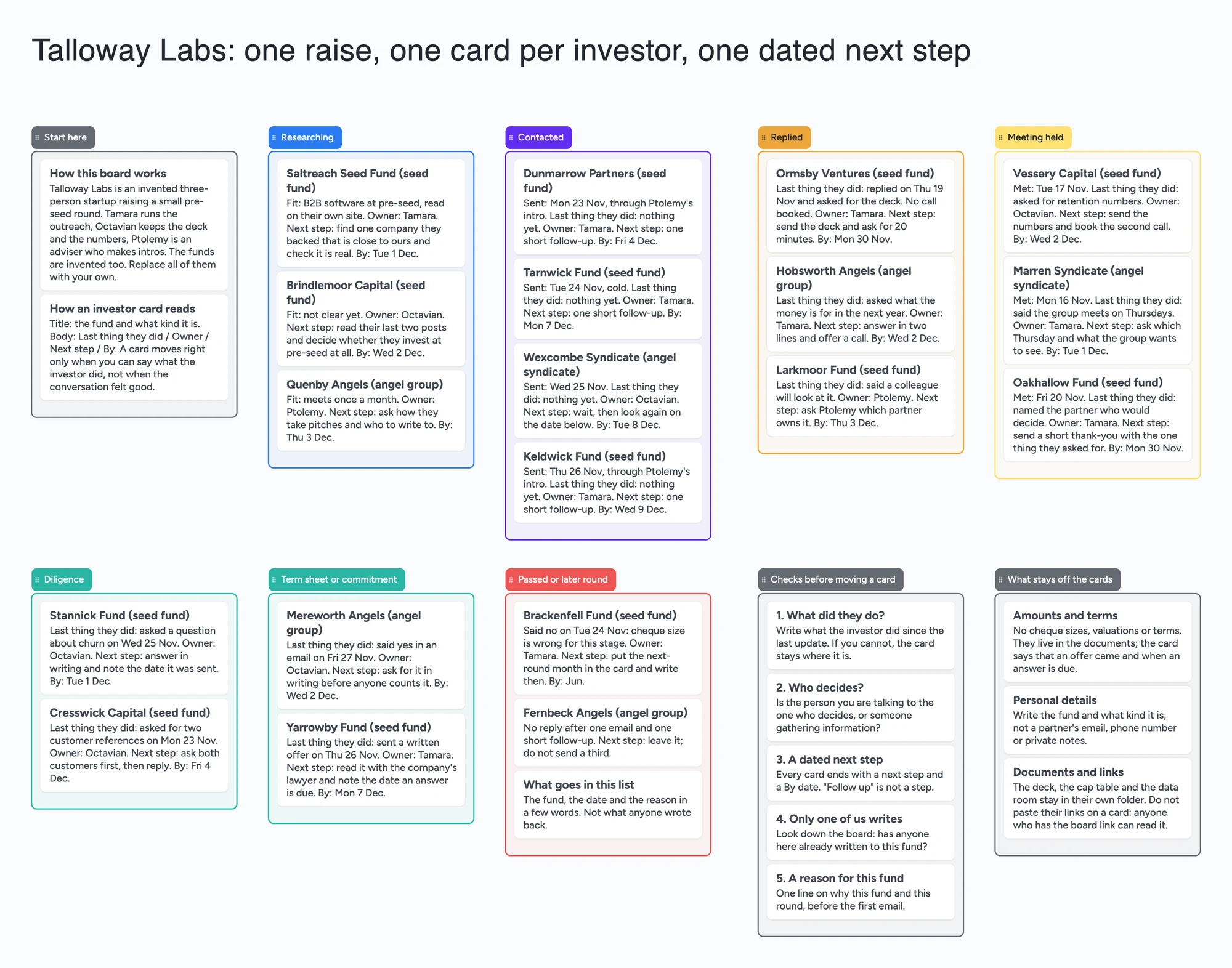
This is a pipeline board for a founding team that wants to see every investor, who owns the next step and what the investor last did, on one screen. It sends no email, syncs no inbox, sets no reminders and holds no amounts, terms or contact details. A spreadsheet, Airtable or an investor CRM does the big-list and email jobs better. The board below is filled in for an invented startup, Talloway Labs, with three people and nineteen funds and angel groups, and it is yours to copy once you open it and sign in for free.
Opens in your browser. Anyone can view; a free sign-in lets you edit.
Updated
The short version
- What it is: one screen where two or three founders see every investor in a raise, what each one last did, who owns the next step and by when. Talloway's board uses 41 of your 150 free items.
- What it holds: the fund and what kind it is, the last thing the investor did, an owner, a next step and a date typed into the card.
- What it is not: no email or calendar sync, no reminders or due-date alerts, no sums, no conversion rates, no data room.
- What stays off it: cheque sizes, valuations, terms, and partners' personal details. A board link is readable by anyone who has it.
- When to skip it: with a long investor list, email tracking or a team that wants reports, a sheet or an investor CRM is the better home (the table below says where).
The one rule: a card moves when the investor did something
Gritt, a fundraising-outreach vendor, published a pipeline guide on November 14, 2026 (the page shows that date). Its table has seven stages (Target, Contacted, Replied, Meeting, Diligence, Term sheet, Closed) and a side track for investors who pass or come back in a later round. The part worth borrowing is its test: before changing a stage, "name what the investor did since the last update", and if there is no specific action, "the record has not progressed".
Talloway's board turns that into one line on every card, "Last thing they did", and a list of five checks before a card moves. The first check is the same question. Our view: for a three-person team the line matters more than the stage names, because a stage is easy to change on a hopeful day and a written "asked for the deck, no call booked" is not.
- A reply is not a meeting. Gritt keeps a deck request without a booked call at Replied; Talloway's Ormsby card says "No call booked" on its face.
- A yes in an email is not a commitment. Gritt reserves Closed for a term sheet, a signed SAFE or a written commitment; Talloway's Mereworth card says to ask for it in writing before anyone counts it.
- A pass keeps its reason. Gritt logs a clear no with its reason and moves "not this fund, but keep us posted" to a later round; Talloway's Passed list does the same in a few words.
When a sheet, Airtable or an investor tool is the better choice
| Tool | What the page or thread we read says (read November 27, 2026) | When it wins over this board |
|---|---|---|
| Google Sheets or Excel | Among others, u/wolfballlife, u/windwoke and u/mykosyko in the r/startups thread below say a sheet is enough; u/wolfballlife writes "Raised 7 figures with a big google sheet+calendly". Gritt's guide tells you to "Copy the table into a spreadsheet today" | You have dozens of investors and want columns, sorting, counts per stage and a filter by fund type |
| Airtable | In the r/ycombinator thread below one commenter says they tried Notion and spreadsheets and "ended up back in Airtable because the flexibility mattered more than the polish"; in r/startups u/MajorTemplate says Airtable is enough for a 3-person team | You want one record per fund with fields, linked records and views; this board has none of those |
| Superthread's seed fundraising template | Its page (dated "DEC 11, 2025") says the template is for planning, scheduling and running a fundraise and says founders who used it raised over $250 million; that figure is the vendor's own claim and we did not check it. We did not open the template itself | You already work in Superthread and want its tasks and docs beside the raise |
| Gritt | Its guide ends by saying Gritt matches your company to a database of "45,000+" investors, drafts emails and sends only the ones you approve from your own Gmail | You want the research and the first emails done for you; a board only records what you did |
| Instaboard | One shared board; lists are stages, owners and dates typed by hand; no email, tracking or alerts | Two or three founders share one raise and want to see who owns each next step, without a login for anything else |
Swipe the table sideways to see every column.
Cells quote the sources named in them or give our reading. Where a cell describes a vendor's tool, it is that vendor's claim, and none of these tools' pricing pages were opened for this page.
Talloway's board, list by list
Talloway Labs and everyone in it are invented: Tamara runs the outreach, Octavian keeps the deck and the numbers, and Ptolemy is an adviser who makes intros. The funds and angel groups are made-up names with their kind beside them. An investor card reads Last thing they did, Owner, Next step and By, and a fund sits in one list at a time.
| List | What it holds | In Talloway's board |
|---|---|---|
| Researching (blue) | Funds nobody has written to yet | "Saltreach Seed Fund (seed fund)" Fit: B2B software at pre-seed, read on their own site. Owner: Tamara. Next step: find one company they backed that is close to ours and check it is real. By: Tue 1 Dec |
| Contacted (purple) | An email went out, nothing back yet | "Dunmarrow Partners (seed fund)" Sent: Mon 23 Nov, through Ptolemy's intro. Last thing they did: nothing yet. Owner: Tamara. Next step: one short follow-up. By: Fri 4 Dec |
| Replied (orange) | A person answered; no call is booked | "Ormsby Ventures (seed fund)" Last thing they did: replied on Thu 19 Nov and asked for the deck. No call booked. Owner: Tamara. Next step: send the deck and ask for 20 minutes. By: Mon 30 Nov |
| Meeting held (yellow) | A call happened; the card says what they asked for | "Vessery Capital (seed fund)" Met: Tue 17 Nov. Last thing they did: asked for retention numbers. Owner: Octavian. Next step: send the numbers and book the second call. By: Wed 2 Dec |
| Diligence (green) | The investor is asking questions or for documents | "Stannick Fund (seed fund)" Last thing they did: asked a question about churn on Wed 25 Nov. Owner: Octavian. Next step: answer in writing and note the date it was sent. By: Tue 1 Dec |
| Term sheet or commitment (green) | Something is in writing, or someone said yes and it is not in writing yet | "Yarrowby Fund (seed fund)" Last thing they did: sent a written offer on Thu 26 Nov. Owner: Tamara. Next step: read it with the company's lawyer and note the date an answer is due. By: Mon 7 Dec |
| Passed or later round (red) | A no, a silence, or "come back next round" | "Brackenfell Fund (seed fund)" Said no on Tue 24 Nov: cheque size is wrong for this stage. Owner: Tamara. Next step: put the next-round month in the card and write then. By: Jun |
Swipe the table sideways to see every column.
The board's own wording. On this board the owner and the date are typed in the card text.
Three lists are not stages: Start here, and two grey lists at the end. One holds the five checks before a card moves; the other, What stays off the cards, repeats the limits below.
What two founder threads say about tracking a raise
In an r/startups thread ("Best CRM for raising rounds", posted November 2, 2023 UTC by u/Say_No_to_rAAV; Reddit shows 29 comments, the archive's comment tree lists 30 with 2 removed, and we read the 28 with text), the poster asks for a CRM for a three-person, fully remote team. Replies split: several say a sheet is enough (u/wolfballlife, u/windwoke, u/mykosyko), one suggests Airtable for three people (u/MajorTemplate), one says "You should absolutely not be using marketing automation features with VCs" (u/aidanlister), and others name tools. The poster says the job is managing the funnel across distributed founders, board and advisers, which is the part a shared board covers.
In an r/ycombinator thread ("Founders raising pre-seed/seed/Series A: how do you actually manage fundraising?", posted June 8, 2026 UTC by u/Eddy399; Reddit shows 19 comments, the archive's comment tree lists 18 with 2 removed, and we read the 16 with text), u/pikeraseo says founders who raised tracked "stage, conviction level, objections, and next steps" in a spreadsheet and "start with Gmail + Google Sheets". u/Negative_Scratch4354 lists the fields they kept: firm, partner, stage, last contact date, next action and a notes column "you actually update". Several replies in that thread name or promote a product, among them withbase.ai, InvestorMatch.pro and Metal; we count them as vendor replies, not evidence. In the same comment as the fields line, u/Negative_Scratch4354 also mentions a firm called Backpocket and invites a DM, so that comment is partly a pitch.
u/binaryvexe, replying in the same thread, wrote that "every time I've tried to run this in a spreadsheet it turns into chaos after like 20 investors". That is one commenter's view. Talloway's board adds nothing up and sorts nothing either, so a long list is where a sheet wins (see the limits below).
What stays off a board anyone can open
A shared board link can be read by anyone who has it, and Pro adds invite-only boards. That decides what goes on a card:
- Amounts, valuations and terms stay in the documents. A card says an offer came and when an answer is due, not what it said.
- Partners' personal details stay off. Write the fund and what kind it is, not an email address, phone number or private note.
- Decks, cap tables and the data room stay in their own folder. Gritt's guide says to link each diligence item to its file in the data room so there is one current version; on this board, do not paste those links on a card.
- Nothing here is legal or financial advice. Gritt's own guide says founders are responsible for complying with securities law when they solicit investment; the board only records who you wrote to and what they did.
Use it for your own raise
- Open the board and delete Talloway's fund cards from each list in turn. The list titles can stay, or become your own stage names.
- Write why this fund on each Researching card in one line before anyone sends a first email; the fifth check asks for it.
- Add one card per fund, the fund and its kind in the title, then Last thing they did, Owner, Next step and By. A fund goes in one list at a time.
- Share it. Set Share to "Anyone who joins can edit" so the second founder can move cards (new boards start view-only); each person signs in free to write. A copy takes 1 of your 5 boards.
- Read the checks aloud before a card moves. What did they do, who decides, what is the dated next step.
- Count the items. Each list and each card is 1 of your 150 free items across all your boards; arrows, sections and pen strokes don't count. Talloway's board is 10 lists + 30 cards + 1 title text box = 41. With 11 cards that are not funds, N funds make N + 22 items, so 40 funds are 62 and 58 funds are 80 (our arithmetic; Gritt cites research putting a typical successful seed process at about 58 investors contacted, and calls those benchmarks a planning reference, not a promise). The 150 free items run out at 128 funds.
What this board can't do
- No follow-up reminders. Gritt's guide suggests logging a follow-up date for every contacted investor; here the By date is text on the card, and someone has to read the board.
- No counts or conversion rates. Gritt's guide wants separate counts for emails sent, replies, positive replies and meetings; this board does not add anything up. Count by hand or in a sheet.
- No inbox or calendar link. It does not see your email, so a reply does not move a card.
- No history of who changed what. We found no history panel on the board; the dates are only what someone typed.
- Not built for a long list. With dozens of funds, a sheet, Airtable or an investor CRM is the better home.
Start from the ready board
It opens in your browser in a few seconds, with nothing to install. Sign in for free when you want to save it and share it.
Questions
Is there a fundraising pipeline template for a small team?
Yes, in several forms: spreadsheets, Airtable bases, Notion and Superthread templates and investor CRMs. This one is a ready board with a list for each step from research to a written commitment, a last-thing-they-did line on every investor card and a dated next step. It is built for a raise of a few dozen investors and two or three founders, not for a long list.
What stages should a fundraising pipeline have?
The guide we read, from the vendor Gritt, uses Target, Contacted, Replied, Meeting, Diligence, Term sheet and Closed, plus a side track for passes and later rounds. This board uses Researching, Contacted, Replied, Meeting held, Diligence, Term sheet or commitment and Passed or later round. Rename any list to match yours.
Does the board store amounts, terms or investors' contact details?
No. Anyone with the link can read a shared board, so Talloway's cards name the fund and what kind it is, not a partner, and they carry no cheque sizes, valuations or terms. The card says that an offer came and when an answer is due.
Can it remind me to follow up?
No. It sends no reminders or due-date alerts. The By date is text on the card; a calendar, a task app or an investor CRM is the place for reminders.
How many investors fit before the free limit?
Talloway's board is 41 items with 19 fund cards. Each extra fund card is 1 more of your 150 free items, so the free items run out at about 128 funds on one board, our arithmetic.
Is Instaboard free?
There is a free plan: 5 boards, 150 cards and items across your account (pen strokes, arrows and sections don't count), and 3 pictures and 1 file per board. Anyone with the link can read a board; writing on it takes a free sign-in. Pro removes the item limit and adds invite-only boards: $5 a month billed yearly ($59.99 a year), or $7.99 monthly.
Sources
- Gritt: "Fundraising Pipeline Template: A Stage-by-Stage Guide" (page says "Published on Nov 14, 2026"; a vendor guide; read November 27, 2026)
- Superthread: "Seed fundraising template" (page shows "DEC 11, 2025"; a vendor page; read November 27, 2026; the template itself not opened)
- r/startups: "Best CRM for raising rounds" (posted November 2, 2023 UTC by u/Say_No_to_rAAV; replies by u/wolfballlife, u/MajorTemplate, u/windwoke, u/mykosyko, u/aidanlister; Reddit shows 29 comments, the archive's tree lists 30 with 2 removed, we read the 28 with text, November 27, 2026)
- r/ycombinator: "Founders raising pre-seed/seed/Series A: how do you actually manage fundraising?" (posted June 8, 2026 UTC by u/Eddy399; replies by u/pikeraseo, u/Negative_Scratch4354, u/binaryvexe; Reddit shows 19 comments, the archive's tree lists 18 with 2 removed, we read the 16 with text, November 27, 2026)